An embedded, multi-month engagement where I act as the rep development function that should exist but doesn't — directed by the VP, executed on the ground.
Target KPIs agreed upfront — win rate, discounting, pipeline quality, forecast accuracy. The engagement is built backward from outcomes you commit to.
Baseline, individual rep coaching, manager development, group training — embedded with your team for 4 to 5 months. No status meetings about the work; just the work.
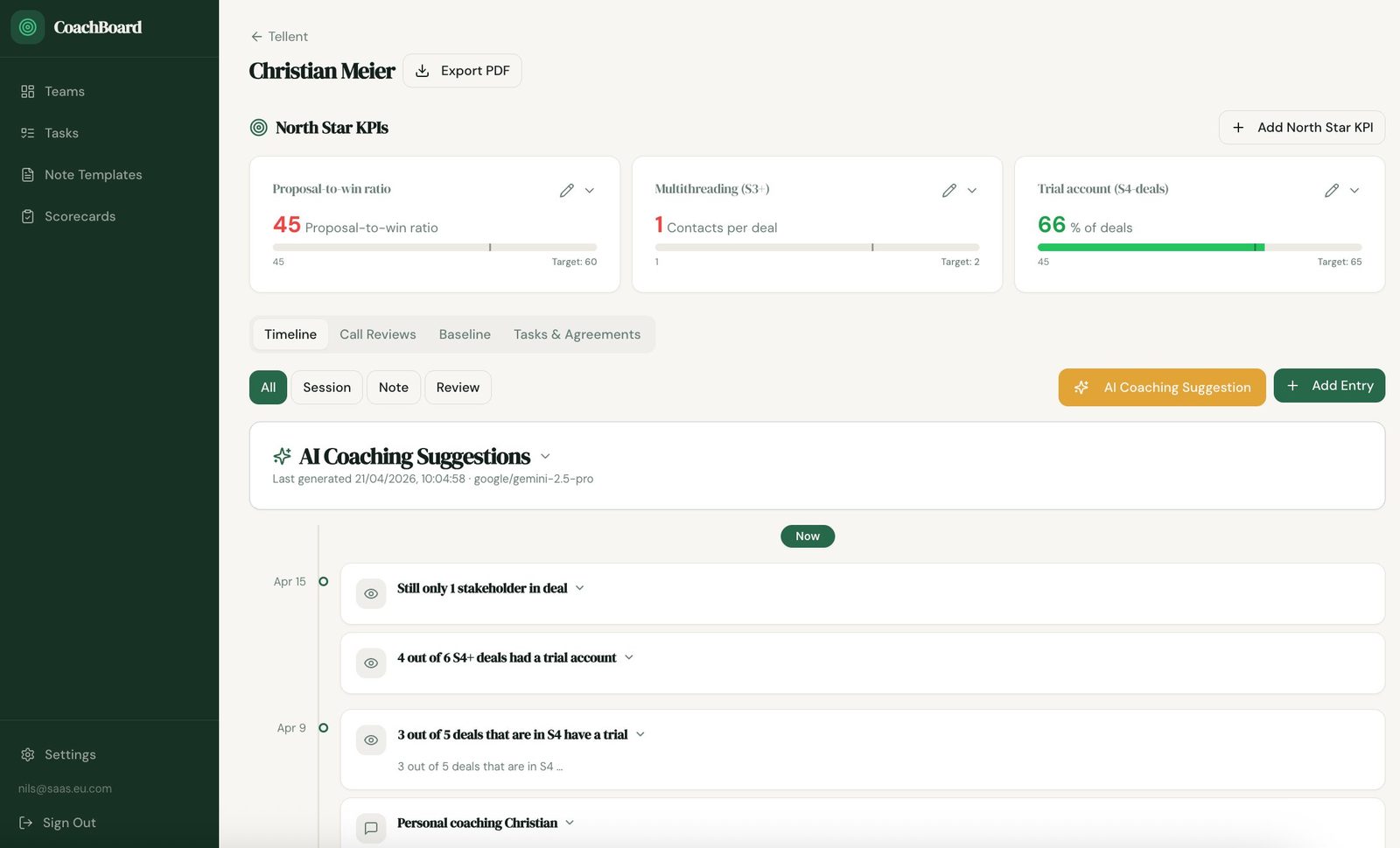
Structured check-ins throughout. KPI progress tracked in Coachboard in real time — no status requests needed. Sign-offs at three milestones across the trajectory.
Most companies invest in training sessions and find habits revert within weeks. The Sales Excellence Trajectory is different: I embed with your team for 4 to 5 months, acting as the rep development function that managers should own but rarely have the bandwidth to execute. The VP+ sets the direction and the target KPIs. I build and run the engagement from the ground up — baseline, individual coaching, manager development in parallel, and a codified commercial system handed over at the end.
I work with managers in parallel throughout — not to explain the method, but to build their coaching capability so the system runs independently after I leave.
After the baseline, each rep gets one coaching focus per month — a leading KPI tied to the VP's high-level targets. Specific, measurable, agreed with the rep directly.
Intensive call reviews, KPI analysis, manager shadowing — 2 to 3 weeks of assessment before a single coaching session runs. The engagement is built on evidence, not assumptions.
Call review scores, KPI progress per rep, coaching session logs — tracked in real time. The VP+ has visibility at any point without needing to ask for a status update.
The structure is consistent. The content is built entirely around what the baseline reveals and the KPIs agreed with the VP+ at the start.
Before anything is built, I map the real gaps — rep by rep, manager by manager. I start with a commercial maturity assessment to understand the company's processes, pipeline quality, and management structure. Then intensive call reviews (minimum 6 per rep), KPI analysis, and manager shadowing. After 2 to 3 weeks I present findings to the VP+ for sign-off, then hold individual sessions with each rep to share my assessment and agree their North Star coaching KPIs — creating explicit buy-in before coaching begins.
Before individual coaching can work, the team needs a shared language and a common quality bar. The first group training is built around the most commonly encountered issues from the baseline — every example comes from the team's own calls. A second training block follows 6 to 8 weeks later as new focus areas emerge from the ongoing coaching work.
After the first training, the weekly rhythm begins — alternating between group training, 1:1 coaching, and group coaching sessions. Each rep works on one North Star KPI per month with structured homework between sessions. Managers are coached in parallel: high-touch shadowing and direct feedback in month one, moving toward independent execution by month three. By then, managers are running their own sessions using the same framework.
The goal is a system that runs without external input after the engagement ends. By this point managers are coaching independently. The final phase documents everything built and hands it over so the work persists — and new hires ramp into the same standards from day one.
Coachboard is a purpose-built tracking tool that logs every coaching session, call review score, and KPI movement throughout the engagement. The VP+ has access at all times — progress is visible, not just reported at milestones.
Each rep has a live coaching plan showing their North Star KPI, current score versus target, recent call review trends, and upcoming homework. Managers have their own view showing team-wide patterns and coaching session activity.
The pattern is consistent across companies. Static, RevOps-driven elements score well — they can be built once and left running. The closer a capability gets to daily management practice, the lower it scores. The Sales Excellence Trajectory closes that gap by working on reps and managers simultaneously, with the VP+ holding the direction.
Across 20+ B2B SaaS companies assessed, the picture is the same: strategy is in place, the playbooks exist, the tooling is mature. What's missing is the daily management layer that turns all of that into rep behaviour. Without it, the same gaps reappear quarter after quarter.
A training sets a standard. Without a manager reinforcing it in 1:1s and pipeline reviews, reps revert to their habits within weeks. This engagement builds the management layer in parallel — so standards are enforced long after the final session ends.
Scores from the B2B SaaS Commercial Maturity Report — assessments of 20+ B2B SaaS companies across the Netherlands, Belgium, and DACH, conducted between 2019 and 2026. Scale: 0 to 2.
Tell me what you are seeing in the numbers and what you have already tried. I will come back with a view on whether a Sales Excellence engagement is the right fit.