Since 2016, Nils Brosch has kept a knowledge base of articles and statistics on B2B SaaS and AI sales. This page shares the best of them: evergreen findings and fresh 2026/27 data that sales leaders and reps should know.
B2B SaaS leaders frequently compare their win rates, SDR output, pipeline coverage and customer retention against industry averages. Yet a single industry-wide benchmark often hides differences in deal size, segment, geography, sales motion and measurement method.
This resource collects 201 research-backed B2B sales and SaaS statistics from current, recent and selected older primary studies that remain useful in 2026. It focuses on numbers that can help founders, CROs, sales managers and account executives make better decisions. Each statistic links directly to the original source.
About the data: Not every study samples SaaS companies exclusively; some cover broader B2B or general sales populations. Use these numbers as directional comparisons, not universal performance targets. Original data from Nils Brosch's own call reviews and commercial maturity assessments of Benelux and DACH B2B SaaS teams appears alongside the public research in each topic.
1Discovery calls
Discovery is where differentiation is created. Most reps stop at the buyer's pain and never reach what that pain costs.
- Original data 75% of B2B SaaS discovery and demo calls never establish what the buyer's problem costs in time, money, risk or missed opportunity, according to Nils Brosch's 2026 benchmark of 1,400+ manually scored calls in Benelux and DACH. (Source) Only about one in five B2B opportunities captured customer impact, and those deals generated 44% more revenue, according to Winning by Design's analysis of 57,826 opportunities. (Source: Winning by Design newsletter, October 2026)
- Original data CEB research (n = 545) found that teaching buyers something new about their business is the strongest driver of changing their buying direction (0.446). Yet, according to Nils Brosch's 2026 Sales Call Benchmark, at least 73% of sales calls fail to introduce a new insight or perspective. Great sales conversations don't just uncover problems. They change how buyers understand them and why they need to act. (Source)
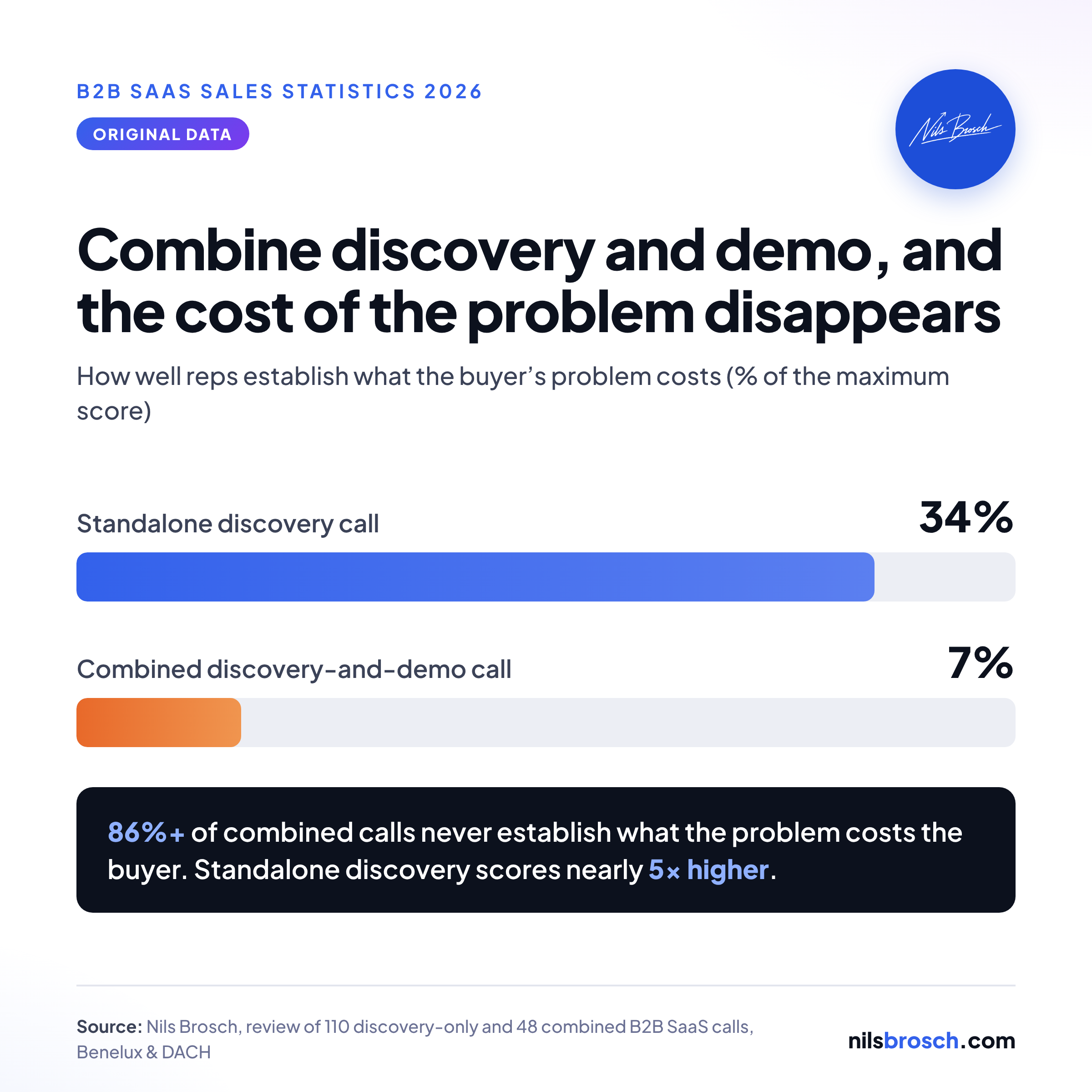
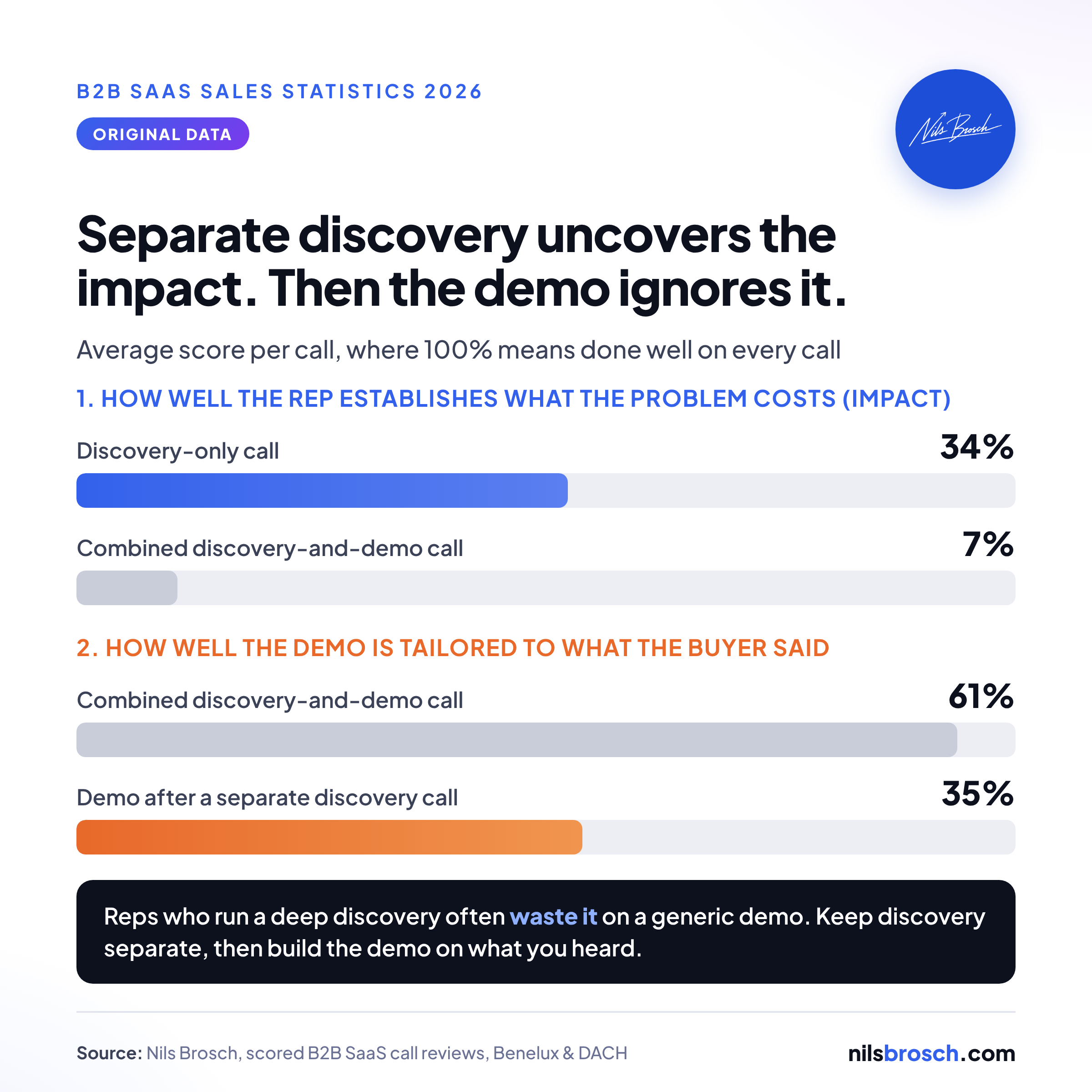
- Original data When discovery and demo are combined in one meeting, at least 86% of calls never establish what the buyer's problem costs; standalone discovery calls score nearly five times higher on this (34% versus 7% of the maximum score), according to Nils Brosch's review of 110 discovery-only and 48 combined calls. (Source)
- Original data Standalone discovery calls go deeper on the buyer's pain than combined discovery-and-demo calls (68% versus 52% of the maximum score) and shift the buyer's view of the problem slightly more often (26% versus 22%), according to Nils Brosch's call reviews. (Source)
- 33% of sales organisations say their sellers struggle to consistently ask purpose-driven questions, according to Richardson's 2026 Selling Challenges study of 300+ sales and enablement professionals. (Source)
- 30% of sales organisations say their sellers struggle to help customers see the cost of keeping the status quo, according to Richardson's 2026 Selling Challenges study. (Source)
- 28% of sales organisations say their sellers struggle to handle stakeholder resistance, according to Richardson's 2026 Selling Challenges study. (Source)
- Sales reps talk for 60% of a sales call and listen for 40% on average, according to Gong's 2025 analysis of 326,000 sales calls. (Source)
- On deals they won, sales reps talked for 57% of the call on average, according to Gong's 2025 analysis of 326,000 calls. (Source)
- On deals they lost, sales reps talked for 62% of the call on average, according to Gong's 2025 analysis of 326,000 calls. (Source)
- Lower-performing sales reps talked for 54% of the call on deals they won and 64% on deals they lost, according to Gong's 2025 research. (Source)
- The most successful discovery calls focus deeply on three to four customer problems, according to Gong's 2017 analysis of 519,000 recorded sales calls. (Source) Older study
- Asking 11 to 14 targeted questions in a discovery call correlates with the highest success rate, while conversations with C-suite buyers work better with fewer questions, according to Gong's 2017 analysis of 519,000 sales calls. (Source) Older study
- Discussing competitors early in the sales cycle in new markets is associated with a 24% higher likelihood of closing the deal, according to Gong's call research. (Source)
2Product demos
Demos are where reps feel most comfortable, yet most demos are not built around what the buyer said in discovery.
- Original data At most 39% of B2B SaaS demos are properly tailored to what discovery uncovered; the rest are partly or wholly a standard product walkthrough, according to Nils Brosch's 2026 benchmark of 1,400+ scored calls. (Source)
- Original data Sales reps properly ask the buyer to confirm that each feature shown is relevant in at most 36% of demos, while at least 54% keep the demo interactive by asking questions throughout, according to Nils Brosch's 2026 call benchmark. (Source)
- Original data Sales reps connect what they demo to what the buyer said far more in a combined discovery-and-demo call (61% of the maximum score) than in a separate demo after a separate discovery call (35%), according to Nils Brosch's call reviews: reps who run a deep discovery often waste it with a generic demo. (Source)
- Involving a sales engineer in enterprise demos or technical discussions raises win rates by up to 30%, according to Gong's 2025 research. (Source)
- B2B deals in which sellers used generic social proof closed at a 22% lower rate, according to Gong's analysis of 46,006 B2B deals. (Source) Older study
- Using broad customer proof in early-stage sales calls is associated with a 47% lower close rate, according to Gong's analysis of 46,006 B2B deals; relevant, specific customer stories work better. (Source) Older study
3The B2B buying journey and vendor shortlists
Most buying decisions are shaped long before a seller joins the conversation.
- The average B2B purchase journey lasted 10.1 months in 2025, down from 11.3 months in 2024, according to 6sense's Buyer Experience Report. (Source)
- B2B buyers made first contact with vendors 61% of the way through their buying journey in 2025, compared with 69% in 2024, according to 6sense. (Source)
- In 95% of B2B purchases, the winning vendor was already on the buying group's shortlist on day one, according to 6sense's 2025 Buyer Experience Report. (Source)
- B2B buying groups evaluated an average of 5.1 vendors per purchase in 2025, according to 6sense. (Source)
- B2B buyers already had prior experience with 3.8 of the 5.1 vendors they evaluated, on average, according to 6sense's 2025 research. (Source)
- B2B buyers started their purchase journey with an average of 3.6 vendors already on their shortlist, according to 6sense. (Source)
- 94% of B2B buying groups ranked their vendor shortlist before speaking to any seller, according to 6sense's 2025 Buyer Experience Report. (Source)
- 79% of first conversations between B2B buyers and vendors were initiated by the buyer, not the seller, according to 6sense's 2025 research. (Source)
- The first vendor a B2B buyer contacted went on to win 77% of deals, according to 6sense's 2025 research. (Source)
- When B2B buyers had not ranked vendors before talking to sales, the first vendor contacted still won 57% of deals, according to 6sense. (Source)
- Each member of a B2B buying group had roughly 16 interactions with the winning vendor during the purchase, according to 6sense's 2025 research. (Source)
4Buyers, AI and self-service
Buyers now research with AI and prefer to do much of the work alone, but they still turn to sellers to check what they found.
- 94% of B2B buyers used large language models such as ChatGPT during their buying process, according to 6sense's 2025 Buyer Experience Report. (Source)
- 58% of B2B buyers said evaluating the AI capabilities of vendor products made them contact sellers earlier, according to 6sense. (Source)
- 67% of B2B buyers prefer a buying experience without a sales rep, according to a 2026 Gartner survey of 646 buyers. (Source)
- 45% of B2B buyers used AI during a recent purchase, according to Gartner's 2026 buyer survey. (Source)
- 69% of B2B buyers prefer to check AI-generated insights with a sales rep, according to a 2026 Gartner survey of 645 buyers. (Source)
- B2B buyers consulted an average of seven information sources during a recent purchase, according to Gartner's 2026 research. (Source)
- 51% of B2B buyers expect to find misleading information from generative AI, almost the same as the 49% who expect it from a sales rep, according to Gartner's 2026 research. (Source)
- 78% of B2B sales leaders say their buyers prefer self-service digital experiences, according to Allego and LXA's 2025 State of Sales Enablement survey of 101 senior leaders. (Source)
5What buyers expect, and why deals stall
Buyers want relevance, proof of ROI and help building consensus. When they do not get it, deals stall.
- 73% of B2B buyers actively avoid suppliers that send irrelevant messages, according to Gartner's 2026 research. (Source)
- 57% of B2B buyers hit several moments where they stopped making progress and delayed a purchase unnecessarily, according to Gartner's 2026 research. (Source)
- B2B buyers were 13 times more likely to report a high-quality deal when there was little dysfunction in their buying group, according to Gartner's 2026 research. (Source)
- 75% of B2B buyers who had their value confirmed by a sales rep reported a high-quality deal, according to Gartner's 2026 research. (Source)
- 69% of sales professionals say measurable ROI has become more important to their customers than a year ago, according to Salesforce's 2026 State of Sales report. (Source)
- 67% of sales professionals say personalization has become more important to their customers, according to Salesforce's 2026 State of Sales report. (Source)
- 67% of sales professionals say their customers need extensive education before they buy, according to Salesforce's 2026 State of Sales report. (Source)
- 57% of sales professionals say customers now take longer to make a decision than they used to, according to Salesforce's 2026 State of Sales report. (Source)
- Poor product fit (37%) and poor value for money (35%) are the leading reasons B2B deals fail, according to HubSpot's 2025 sales survey. (Source)
- The average B2B deal now requires 12.4 touchpoints, up from 9.2 in 2023, according to Allego and LXA's 2025 State of Sales Enablement survey. (Source)
- Prescriptive sellers, who guide B2B buyers through the purchase instead of simply answering their questions, increase ease of purchase by up to 86% and reduce buyer regret by 37%, according to CEB (now Gartner) research led by Brent Adamson. (Source; Source) Older study
6Cold email
Most cold emails get no reply. The gap between average and top reps is large, and short, offer-led emails perform best.
- The median reply rate for outbound sales emails is 1.8%, according to Gong's 2024 Engage benchmarks. (Source)
- Top-quartile reps achieve a 3.9% reply rate on outbound sales emails, more than twice the 1.8% median, according to Gong's 2024 benchmarks. (Source)
- The median bounce rate for outbound sales emails is 2.7%, against 0.5% for top-quartile reps, according to Gong's 2024 benchmarks. (Source)
- Manually sent sales emails get a 2.1% median reply rate, almost double the 1.1% for automated emails, according to Gong's 2024 benchmarks. (Source)
- Manually sent sales emails have a 37% median open rate, against 33.8% for automated emails, according to Gong's 2024 benchmarks. (Source)
- The average sales rep books about 3 meetings per 1,000 cold emails, roughly one meeting per 344 sends, according to 30 Minutes to President's Club and Gong's 2025 analysis of 85 million cold emails. (Source; report)
- The top 10% of sales reps book about 23 meetings per 1,000 cold emails, 8.1 times the average rep, according to 30MPC and Gong's 2025 cold email analysis. (Source)
- Top-quartile sales reps book 4.3 times more meetings from cold email than the average rep, according to 30MPC and Gong's 2025 analysis of 85 million emails. (Source)
- The top 10% of sales reps get 4.2 times as many replies to cold emails as the average rep, according to 30MPC and Gong's 2025 analysis. (Source)
- The top 10% of sales reps get 2.1 times as many opens on cold emails as the average rep, according to 30MPC and Gong's 2025 analysis. (Source)
- Pitch-heavy language cuts cold email reply rates by up to 57%, according to 30MPC and Gong's 2025 analysis of 85 million emails. (Source)
- Buzzwords and numbers in a cold email subject line cut open rates by up to 17.9%, according to 30MPC and Gong's 2025 analysis. (Source)
- Cold emails under 100 words get the highest reply rates, according to 30MPC and Gong's 2025 analysis of 85 million emails. (Source)
- Cold emails of three to four sentences get the highest reply rates, according to 30MPC and Gong's 2025 analysis. (Source)
- Cold emails that ask directly for the prospect's time get 44% fewer replies, while emails with an offer-led call to action get 28% more, according to 30MPC and Gong's 2025 analysis. (Source)
- The optimal cold email sequence is about six emails over 14 to 28 days; after that, each extra email adds less than 0.5% in replies, according to 30MPC and Gong's 2025 analysis. (Source)
- Rewriting cold prospecting emails to replace bullet-point lists with clearer messaging increased positive responses 3 to 4 times, according to SalesFolk Labs' cold email testing. (Source) Older study
7Cold calling, outreach sequences and lead response
Phone still opens doors, but connect rates are low, and the first seconds of the call and the speed of follow-up decide the outcome.
- The median connect rate for SDR cold calls made inside automated sequences is 1.9%, according to Gong's 2024 Engage benchmarks. (Source)
- Top-quartile SDRs reach a 4.8% connect rate on cold calls made inside automated sequences, according to Gong's 2024 benchmarks. (Source)
- The median connect rate for SDR cold calls made outside automated sequences is 2.9%, according to Gong's 2024 benchmarks. (Source)
- Top-quartile SDRs reach an 8.9% connect rate on cold calls made outside automated sequences, according to Gong's 2024 benchmarks. (Source)
- Starting an outbound sequence with a cold call can double email reply rates, according to Gong's 2024 Engage benchmarks. (Source)
- Leaving a voicemail can double the chance of a reply to the follow-up email, according to Gong's 2024 Engage benchmarks. (Source)
- UK B2B companies need an average of 38.5 outreach touches to create one qualified sales opportunity, according to Salesloft's 2026 UK Revenue Benchmark Report. (Source)
- US B2B companies need an average of 35.2 outreach touches to create one qualified sales opportunity, according to Salesloft's 2026 US Revenue Benchmark Report. (Source)
- 42% of sales professionals say social media gets the best response to cold outreach, ahead of email (26%) and phone (23%), according to HubSpot's 2025 sales survey. (Source)
- Cold callers who say "the reason for my call is..." are 2.1 times more successful, according to Gong's analysis of 90,380 cold calls. (Source) Older study
- Original data In the first seconds of a cold call, sales reps reach 81% of the maximum score for introducing themselves and their company, but only 41% for giving a clear reason for the call and 38% for booking a follow-up, according to Nils Brosch's scored call reviews of Benelux and DACH B2B SaaS teams. Asking permission or an opening question scored 69% and showing knowledge of the prospect's situation 50%. (Source)
- Original data The average sales rep reaches only 56% of the maximum score on a cold call opening, leaving nearly half of a strong opening out before the conversation starts, according to Nils Brosch's scored call reviews using his IPADS framework. (Source)
- Original data SDRs who make fewer than 150 dials a day need about 300 prospects to book one meeting, while SDRs who make more than 200 dials a day need only 65, a 4.6 times difference, as reported by Nils Brosch. (Source)
- Inbound leads contacted within one hour are nearly seven times more likely to be qualified than leads contacted an hour later, and more than 60 times more likely than leads contacted after 24 hours, according to a 2011 Harvard Business Review analysis of 1.25 million inbound leads. (Source) Older study
- Sales executives are the hardest B2B persona to reach, needing an average of 7.03 outreach touches before engaging, compared with 3.96 for Finance VPs, 3.85 for Sales VPs and 3.30 for Marketing VPs, according to Outreach's 2026 Icebox report. (Source)
8Buying committees and multithreading
Deals are won with several stakeholders engaged, not with a single champion.
- 77% of B2B deals involve more than one buyer contact, according to Gong's analysis of 1.8 million opportunities. (Source)
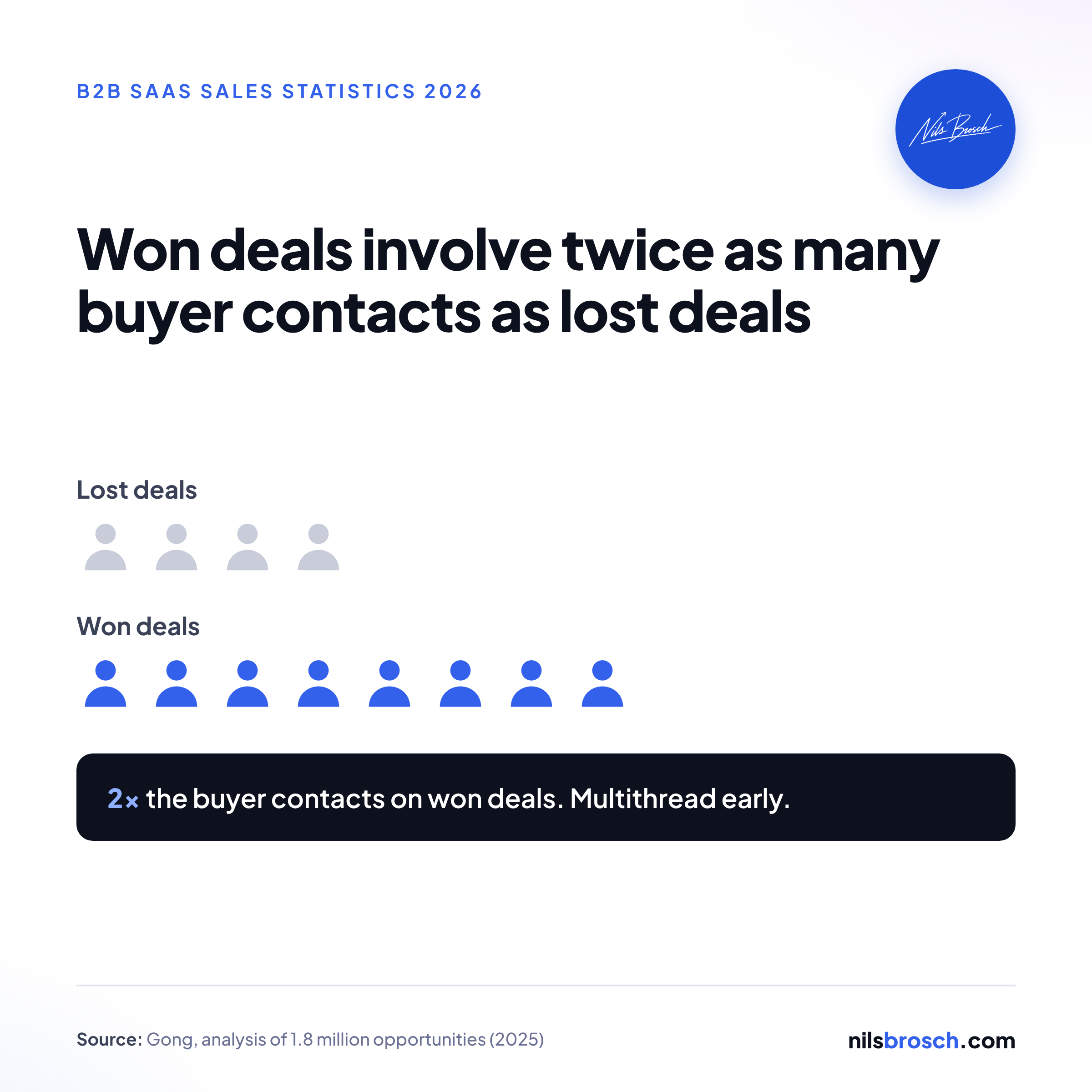
- Won B2B deals involve twice as many buyer contacts as lost deals, according to Gong's analysis of 1.8 million opportunities. (Source)
- Strategic enterprise deals involve an average of 17 buyer contacts, according to Gong's 2025 research. (Source)
- For deals above USD 50,000, engaging multiple stakeholders (multithreading) comes with a 130% higher win rate, according to Gong's 2025 research. (Source)
- Seller teams on won deals are 67% larger than seller teams on lost deals, according to Gong's 2025 research. (Source)
- Deals where only one buyer ever spoke closed 56% of the time, against 87% when four or more buyers spoke, according to Gong Labs' 2026 analysis of more than 120 million sales calls. (Source)
- Involving decision-makers in the first two sales stages raises win rates by 55%, and keeping a strong relationship with decision-makers comes with a 4 times higher win rate, according to Pavilion and Ebsta's 2025 GTM Benchmark Report of 655,000 opportunities. (Source)
- 22.7% of UK revenue leaders say engaging multiple stakeholders is the strongest predictor that a deal will close, according to Salesloft's 2026 UK Revenue Benchmark Report. (Source)
- 22.2% of UK revenue leaders say a strong business case with validated ROI is the strongest predictor that a deal will close, according to Salesloft's 2026 UK report. (Source)
- Original data On at least half of B2B SaaS sales calls, the rep does not properly identify everyone involved in the decision; on at least 43% the internal steps to a signed deal are not properly mapped, and on at least 51% no clear timeline or urgency is established, according to Nils Brosch's 2026 benchmark of 1,400+ scored calls. (Source)
- 85% of sellers lost or delayed at least one deal in the past year because a key client stakeholder changed jobs, according to LinkedIn's State of Sales 2021 report. (Source) Older study
9Next steps, proposals and closing
Deals move faster when the next step is agreed early, and proposals close more often when several stakeholders engage with them.
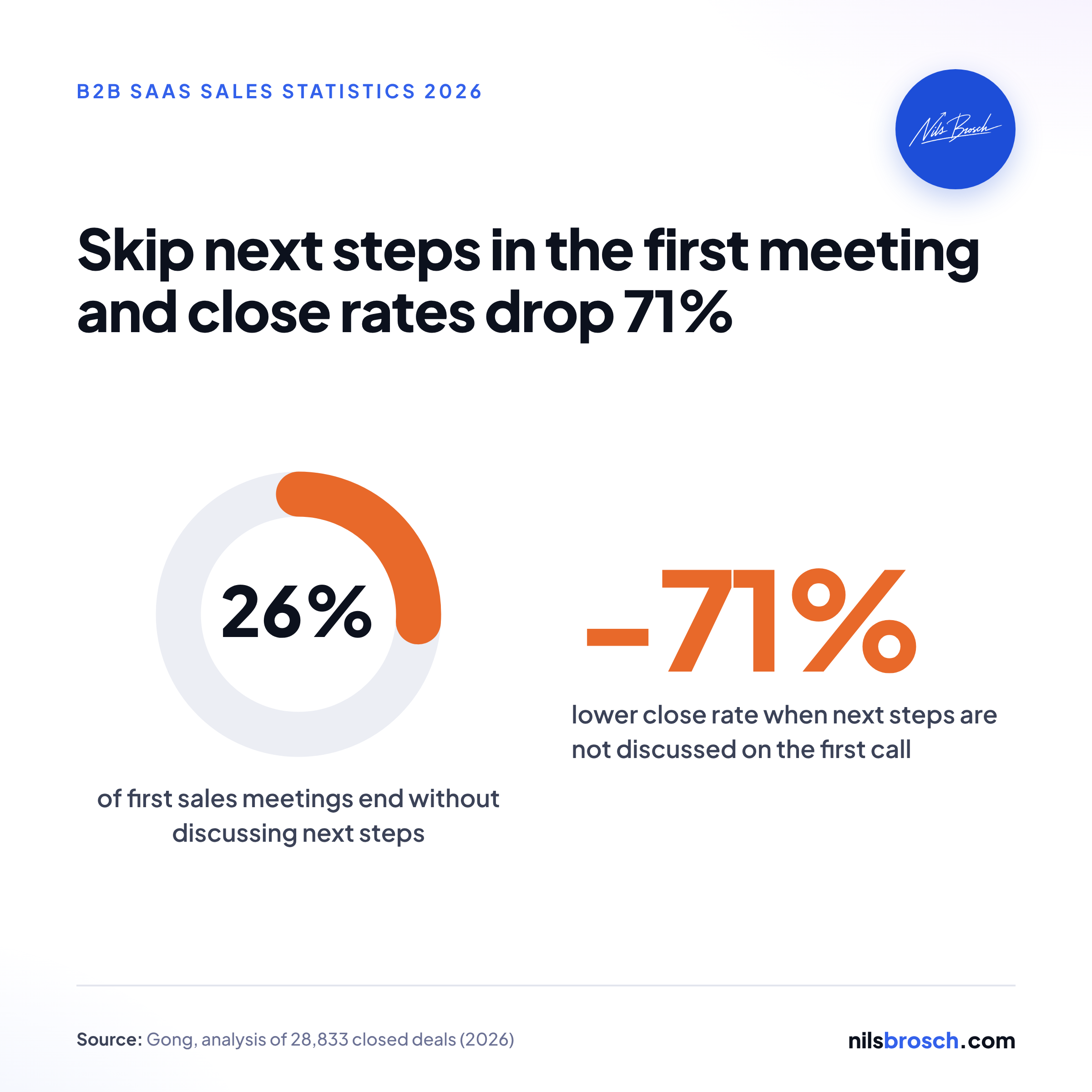
- Sellers fail to discuss next steps in 26% of first sales meetings, and when that happens, close rates are 71% lower, according to Gong's 2026 analysis of 28,833 closed deals. (Source)
- Sellers in the fastest-closing deals spend 53% more time discussing next steps in the first meeting than sellers in slow deals, according to Gong's 2026 sales-cycle analysis. (Source)
- Top-performing sellers close deals in sales cycles that are 42% shorter than those of lower performers, according to Pavilion and Ebsta's 2025 GTM Benchmark Report. (Source)
- B2B proposals close at an average rate of 34%, according to Proposify's 2026 State of Proposals report, which analysed 742,137 proposals worth USD 3.06 billion across 30 industries. (Source)
- Winning sales proposals average 11 pages, against 13 pages for losing proposals, according to Proposify's 2026 State of Proposals report. (Source)
- Only 20% of sales proposals include video, but proposals where the buyer watched a video were 3.3 times more likely to close, according to Proposify's 2026 State of Proposals report. (Source)
- Sales proposals viewed by multiple stakeholders have a 20% higher close rate, according to Proposify's 2026 State of Proposals report. (Source)
- Sales proposals that included a discount had a 75% higher average value (USD 35,000 versus USD 20,000) than proposals without one, according to Proposify's 2026 State of Proposals report. (Source)
- Sales proposals signed with e-signatures close 15% more often and 60% faster, according to Proposify's 2026 State of Proposals report. (Source)
- B2B buyers open a sales proposal an average of 34 minutes after it is sent, and won proposals close an average of 2.5 days after first being opened, according to Proposify's 2026 State of Proposals report. (Source)
- Sales proposals with one requested revision close 18% more often, with two revisions 28% more often and with three revisions 45% more often, according to Proposify's 2026 State of Proposals report. (Source)
- 83% of winning sales proposals contain images, with an average of 12 images each, according to Proposify's 2026 State of Proposals report. (Source)
10How sellers spend their time
Sellers spend less than half of their week actually selling.
- Sales professionals spend only 40% of their working week selling, according to Salesforce's 2026 State of Sales report of 4,050 sales professionals. (Source)
- Sales professionals spend 22% of their working time in customer meetings, according to Salesforce's 2026 State of Sales report. (Source)
- Sales professionals spend 18% of their working time prospecting, according to Salesforce's 2026 State of Sales report. (Source)
- Sales professionals spend 60% of their working time on non-selling activities, according to Salesforce's 2026 State of Sales report. (Source)
- Sales professionals spend 17% of their working time creating quotes, according to Salesforce's 2026 State of Sales report. (Source)
- Sales professionals spend 16% of their working time planning, according to Salesforce's 2026 State of Sales report. (Source)
- Sales professionals spend 13% of their working week on manual data entry, according to Salesforce's 2026 State of Sales report. (Source)
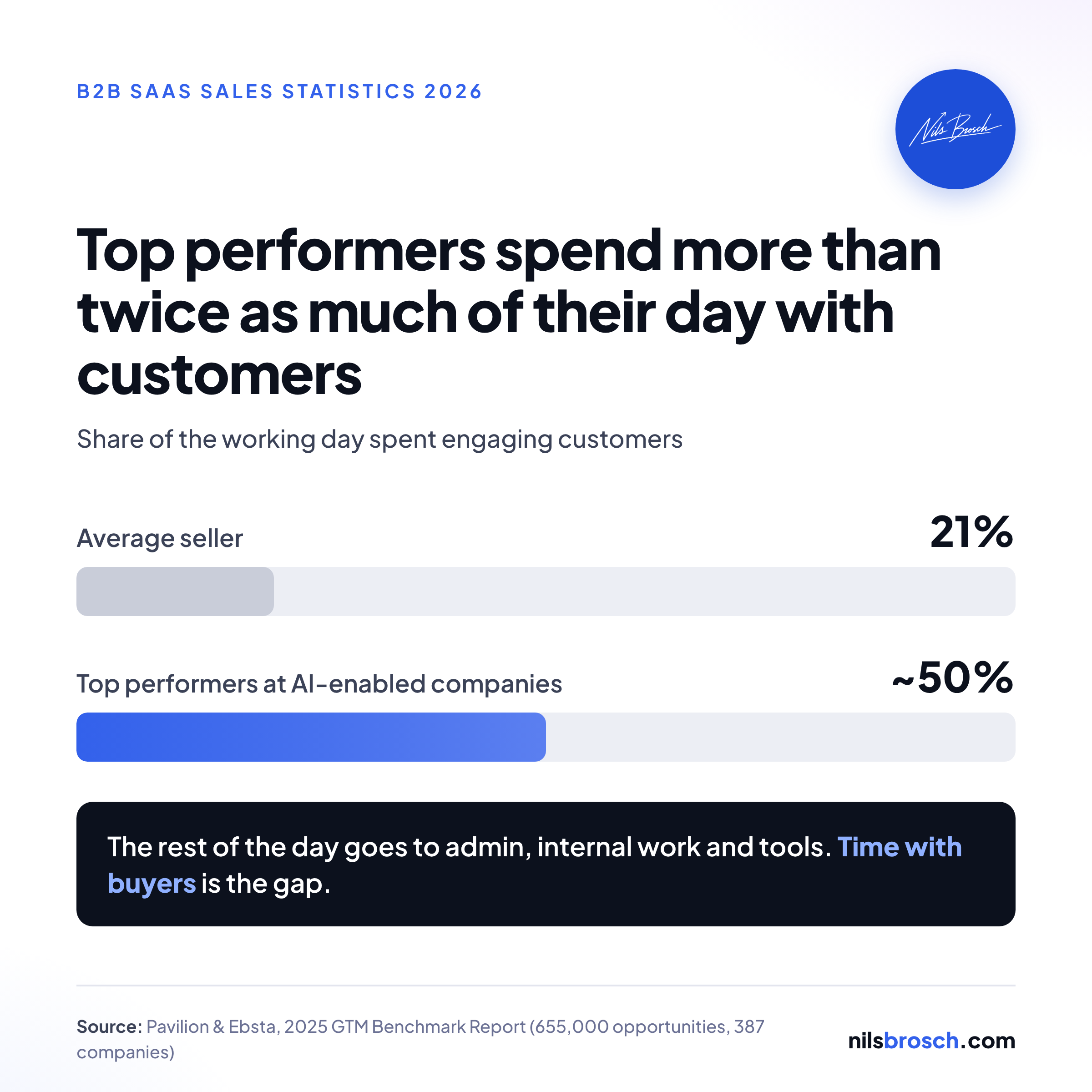
- The average seller spends only 21% of the day engaging customers, while top performers at AI-enabled companies spend nearly 50%, according to Pavilion and Ebsta's 2025 GTM Benchmark Report. (Source)
11Quota attainment and top performers
Fewer than half of reps hit quota, and a small group of top sellers brings in most of the revenue.
- Only 48% of account executives hit quota in 2026, down from 51% in 2024, according to The Bridge Group's 2026 survey of 158 B2B companies. (Source)
- Only 29% of sales professionals hit or exceeded quota in the previous year, according to Richardson's 2026 Selling Challenges study. (Source)
- Average quota attainment among US sales teams is about 62%, according to Salesloft's 2026 US Revenue Benchmark Report. (Source)
- The top 10% of sellers generate 47.4% of closed-won revenue, according to Salesloft's 2026 US Revenue Benchmark Report. (Source)
- Just 14% of sellers generate 80% of revenue, according to Pavilion and Ebsta's 2025 GTM Benchmark Report of 655,000 opportunities across 387 companies. (Source)
- Top-performing sellers manage 2.64 times more deals than lower performers, according to Pavilion and Ebsta's 2025 GTM Benchmark Report. (Source)
- Top-performing sellers have 43% higher win rates than lower performers, according to Pavilion and Ebsta's 2025 GTM Benchmark Report. (Source)
12Account executive quotas, ramp and hiring
AE roles are getting bigger, take longer to ramp and require more experience.
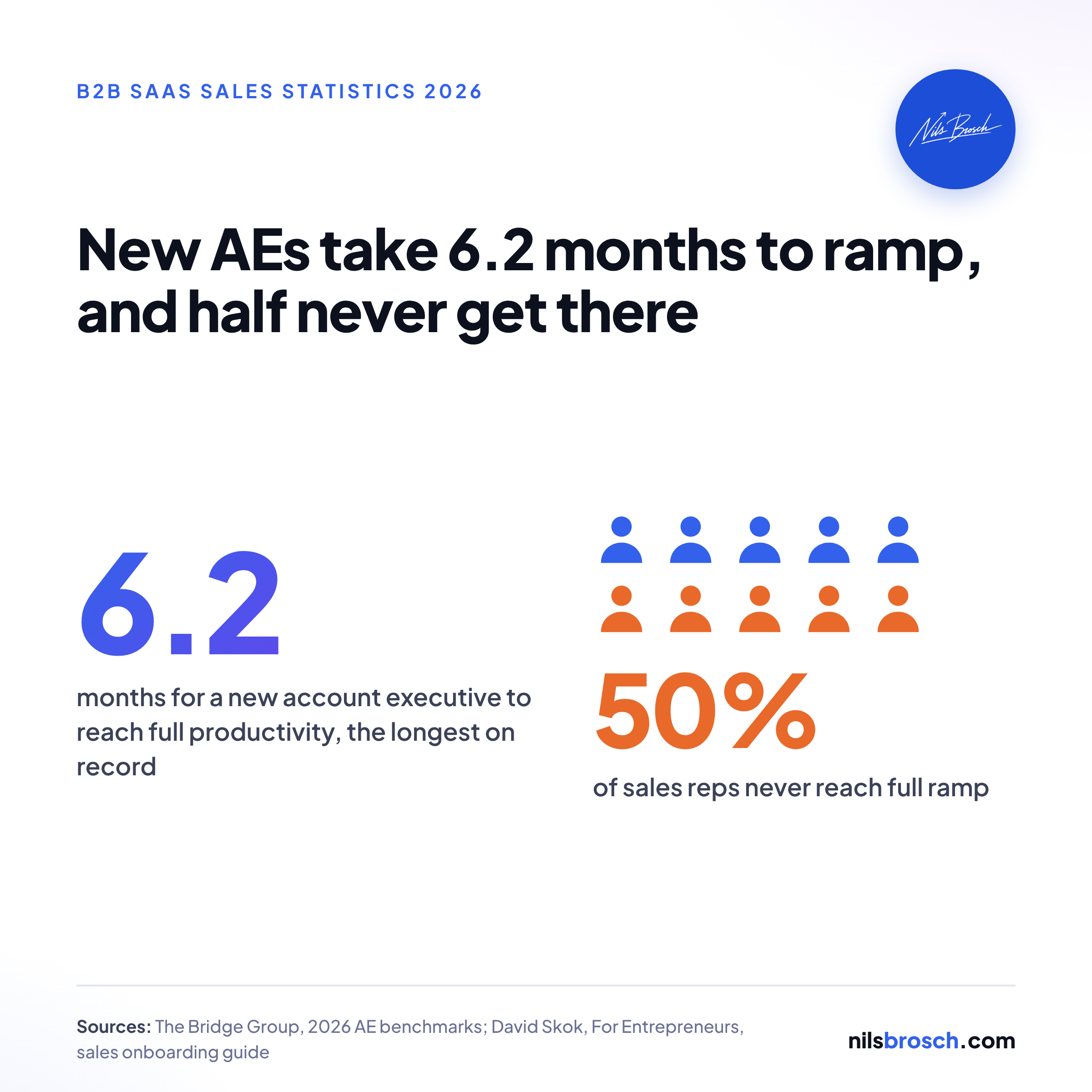
- New account executives take an average of 6.2 months to reach full productivity, the longest in The Bridge Group's research history. (Source)
- B2B companies now require an average of 3.7 years of experience when hiring account executives, up from 2.7 years in 2022, according to The Bridge Group's 2026 research. (Source)
- 38% of B2B companies give account executives sole or shared ownership of renewals and expansion, nearly twice the share in 2024, according to The Bridge Group's 2026 research. (Source)
- 50% of sales reps never reach full ramp, according to David Skok's For Entrepreneurs guide to sales onboarding. (Source)
13Sales management, pipeline and coaching
Managers face bigger pipeline targets but often cannot see why deals stall, and coaching is the weakest discipline in most sales teams.
- 68.4% of US sales and revenue leaders say their pipeline targets have increased, according to Salesloft's 2026 US Revenue Benchmark Report. (Source)
- 71.9% of UK revenue leaders say their pipeline targets have increased, according to Salesloft's 2026 UK Revenue Benchmark Report. (Source)
- US revenue leaders estimate that 19.7% of their pipeline is affected by slipped close dates, stalled deals and other execution problems, according to Salesloft's 2026 US report. (Source)
- Only about 32% of US revenue leaders can immediately diagnose why a deal has stalled, according to Salesloft's 2026 US report. (Source)
- 89% of US revenue leaders believe their managers assess seller performance objectively, according to Salesloft's 2026 US report. (Source)
- 42% of sales professionals say ARR is their most important success metric, according to HubSpot's 2025 sales survey. (Source)
- Fewer than 5% of sales professionals rank pipeline coverage, lead scoring or sales linearity among their top success metrics, according to HubSpot's 2025 sales survey. (Source)
- Original data The three weakest commercial capabilities in B2B SaaS companies are all owned by management: companies reach only 17% of the maximum score on Practice (recurring coaching and skill practice), 24% on Playbook and 25% on Process, according to Nils Brosch's 15-P Commercial Maturity assessments of 12 to 16 companies per capability. (Source; percentages)
- Original data The strongest commercial capabilities in B2B SaaS companies are static assets that live in documents, and even these reach only about half of the maximum score: Pages/CRs 56%, Product 51% and Prices 50%, with Performance Analysis at 30%, according to Nils Brosch's 15-P assessments. (Source)
- Original data B2B SaaS companies reach only 36% of the maximum score on Personas: they know what they sell, but not which pains and language convert for each buyer persona, according to Nils Brosch's 15-P assessments. (Source)
- Specialised sales teams achieve 7% higher close rates than generalist teams, according to XANT's analysis of sales organisations. (Source) Older study
- A disciplined deal-review programme cut forecast variance to 3% within one quarter in one sales organisation's case. (Source)
14AI in sales teams
Most sales teams use AI, but only a minority can show measurable results from it.
- 85% of GTM teams that use AI report a productivity boost, according to Scale Venture Partners and Benchmarkit's 2025 State of GTM AI survey of 278 GTM leaders. (Source)
- Sellers who frequently use AI tools generate 77% more revenue than sellers who do not, according to Gong's analysis of 7.1 million opportunities. (Source)
- In companies that use AI most heavily, 57% of reps hit quota, against 39% in companies that use it least, according to The Bridge Group's 2026 research. (Source)
- 94% of sales leaders who already use AI agents say they are critical to meeting business demands, according to Salesforce's 2026 State of Sales report. (Source)
- 84% of sales teams without an all-in-one platform plan to consolidate their sales technology, according to Salesforce's 2026 State of Sales report. (Source)
- Only 20.6% of US revenue leaders say their AI deployments are production-ready with measurable outcomes, according to Salesloft's 2026 US Revenue Benchmark Report. (Source)
- 28.2% of US revenue leaders say they are still experimenting with AI, according to Salesloft's 2026 US report. (Source)
- 28.3% of UK revenue leaders say their AI deployments are production-ready with measurable outcomes, according to Salesloft's 2026 UK Revenue Benchmark Report. (Source)
- 23.4% of UK revenue leaders say they are still experimenting with AI, according to Salesloft's 2026 UK report. (Source)
- 83% of sales professionals say AI helps them personalize interactions with prospects, according to HubSpot's 2025 sales survey. (Source)
- 82% of sales professionals say AI surfaces better insights from their data, according to HubSpot's 2025 sales survey. (Source)
- 77% of senior B2B sales leaders say advancing sales enablement is important to business performance, according to Allego and LXA's 2025 State of Sales Enablement survey. (Source)
- 69% of senior B2B sales leaders regard AI as essential to improving sales team efficiency and performance, according to Allego and LXA's 2025 survey. (Source)
- 70% of senior B2B sales leaders say every sales professional will need AI literacy to stay relevant, according to Allego and LXA's 2025 survey. (Source)
- 41% of senior B2B sales leaders expect AI agents to replace 5% to 25% of sales roles within two years, according to Allego and LXA's 2025 survey. (Source)
- 76% of sales enablement leaders say poor adoption of sales tools is the main reason reps miss quota, according to Allego and LXA's 2025 research. (Source)
- B2B sellers who received AI feedback remembered 50% more content after 48 hours than sellers who received human feedback, according to Allego's 2025 biometric coaching study. (Source)
- The number of B2B deals in which AI was discussed rose 85% between February 2024 and June 2026, according to Gong Labs' analysis of 33.5 million deals across 3,398 companies. (Source)
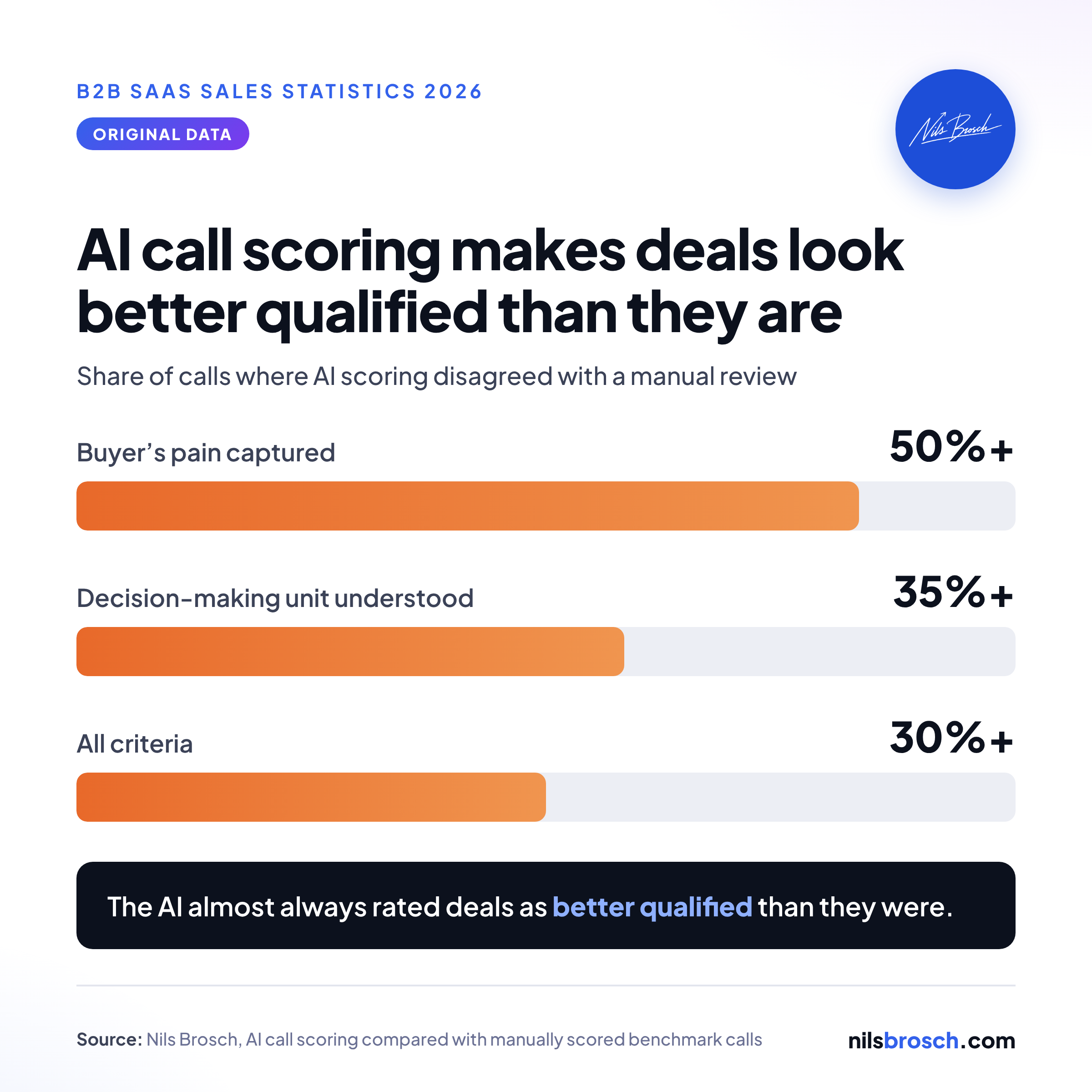
- Original data AI call-scoring tools disagree with a manual review on more than 50% of calls when judging whether the buyer's pain was captured, more than 35% on whether the decision-making unit was understood and more than 30% across all criteria, almost always rating deals as better qualified than they are, according to Nils Brosch's comparison against his manually scored benchmark calls. (Source)
- 87% of US revenue organisations used AI in 2025, and another 9% planned to adopt it within 12 months, according to Gong Labs' State of Revenue AI 2026 report. (Source)
- Revenue teams using revenue-specific AI tools report 13% higher revenue growth and 85% greater commercial impact than teams using generic AI tools, according to Gong Labs' State of Revenue AI 2026 report. (Source)
- Revenue teams that treat AI as a core part of their go-to-market strategy report 31% higher revenue growth, a 65% greater chance of increasing win rates and 2.6 times the commercial impact, according to Gong Labs' State of Revenue AI 2026 report. (Source)
- 43% of revenue leaders expect AI to transform sales jobs without cutting headcount, 28% expect it to eliminate jobs and 21% expect it to create new roles, according to Gong Labs' State of Revenue AI 2026 report. (Source)
- The number of US companies using AI for forecasting and strategic decisions grew 50% year over year in 2025, according to Gong Labs' State of Revenue AI research. (Source)
15GTM channels, free trials, founder-led sales and buying signals
Early-stage companies still lean on founder-led sales and networks, AI search and signal-based outbound are growing fast, and sales help still lifts free-trial conversion.
- Free trials with sales assistance convert at a median of 15.5%, nearly four times the 4% median for unassisted trials, according to Redpoint's 2019 free-trial survey of SaaS companies. (Source) Older study
- Top-quartile SaaS companies convert 12% of unassisted free trials and 30% of sales-assisted trials into paying customers, according to Redpoint's 2019 free-trial survey. (Source) Older study
- Free trials limited by time or usage convert at least twice as well as trials limited by features or seats, according to Redpoint's 2019 free-trial survey. (Source) Older study
- Asking for payment details before a free trial is associated with 2.5 times higher conversion, yet only about 12% of SaaS companies require it, according to Redpoint's 2019 free-trial survey. (Source) Older study
- 75% of SaaS companies use salespeople to follow up with free-trial users, according to Redpoint's 2019 free-trial survey. (Source) Older study
- Founder-led sales is the primary go-to-market motion for 44% of software companies below USD 1 million ARR and the second most common motion for 26% of companies at USD 1 to 10 million ARR, according to Growth Unhinged's 2026 State of B2B GTM survey of 300 software GTM leaders. (Source)
- Software companies use an average of 5.5 core go-to-market channels, up from five in 2025, according to Growth Unhinged's 2026 State of B2B GTM survey. (Source)
- The most common core GTM channels for software companies are networks and introductions (62%), SEO (51%) and LinkedIn posting by founders and employees (50%), according to Growth Unhinged's 2026 survey. (Source)
- 50% of software companies are experimenting with signal-based outbound and 41% with AI search, according to Growth Unhinged's 2026 State of B2B GTM survey. (Source)
- AI search is now a core GTM channel for 39% of software companies, up 11 percentage points from 2025, according to Growth Unhinged's 2026 survey. (Source)
- Among software companies with deal sizes below USD 5,000, 35% use product-led growth as their primary motion and 17% use inbound, according to Growth Unhinged's 2026 survey. (Source)
- Among software companies with deal sizes above USD 50,000, the primary motions are outbound (31%), inbound (24%) and account-based GTM (19%), according to Growth Unhinged's 2026 survey. (Source)
- The buying signals GTM teams act on most are content engagement (52%), website visits (42%) and product usage (40%), according to Growth Unhinged's 2026 State of B2B GTM survey. (Source)
- Partner referrals are the most efficient source of B2B pipeline, scoring 1.3 on an efficiency index (win rate × deal size ÷ sales cycle), ahead of organic inbound (1.2), outbound (1.05), events (0.78) and paid channels (0.68), according to Pavilion and Ebsta's 2025 GTM Benchmark Report. (Source)
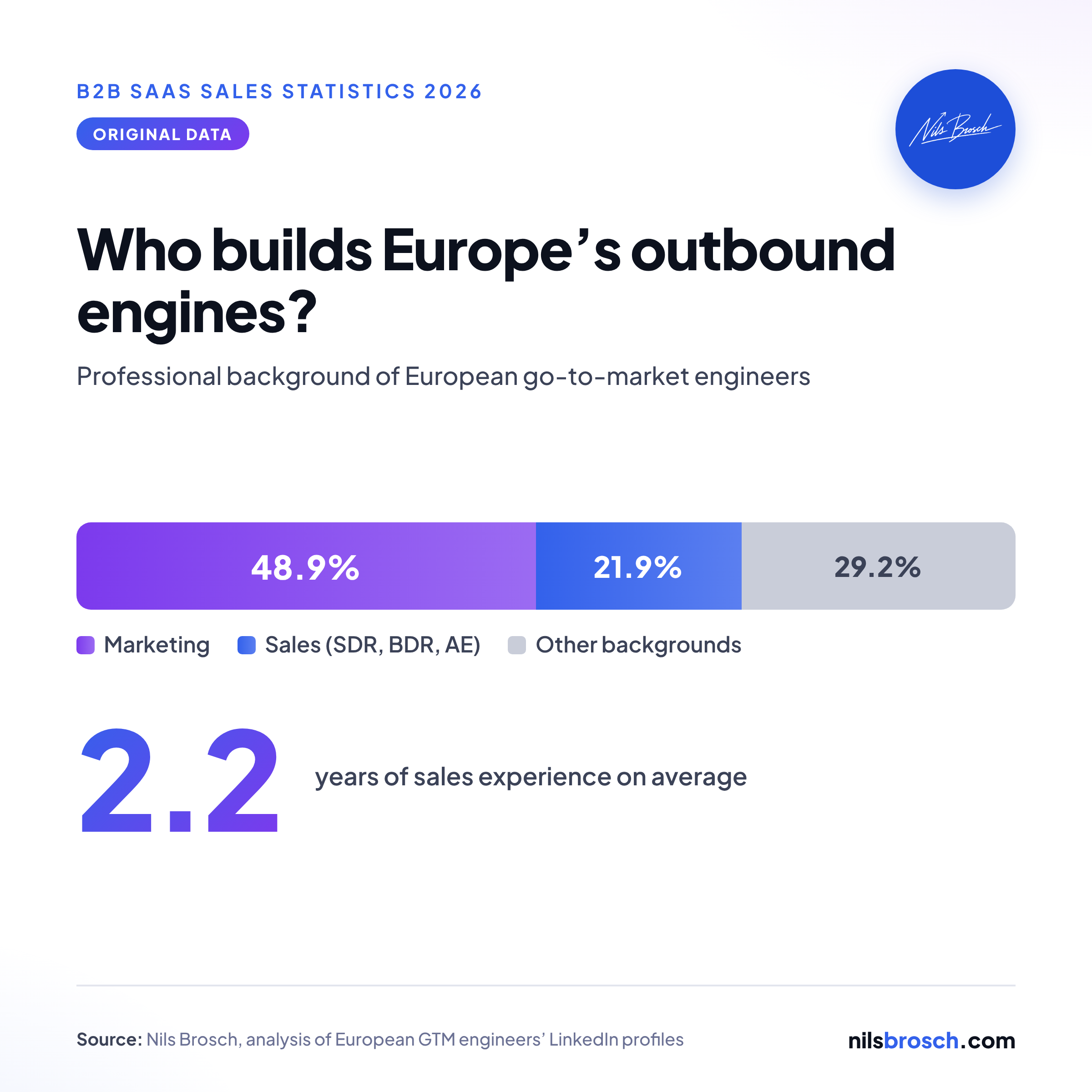
- Original data 48.9% of European go-to-market engineers come from a marketing background and 21.9% from a sales background (SDR, BDR or AE), with an average of 2.2 years of sales experience, according to Nils Brosch's analysis of European GTM engineers' LinkedIn profiles. (Source)
- Original data Of European go-to-market engineers who state a view on mass cold mailing, 111 are positive, 107 show no clear view, 15 are balanced and only 3 are hesitant, according to Nils Brosch's analysis of their LinkedIn profiles. (Source)
16SaaS growth, retention and expansion
Growth has slowed, and expansion from existing customers now drives a large share of new revenue.
- Median ARR growth at public SaaS companies fell from 34% in late 2021 to about 15% in January 2026, according to David Spitz's BenchSights analysis. (Analysis; data tool)
- SaaS companies above USD 50 million ARR generate roughly 60% of their new ARR from existing customers, according to High Alpha's 2025 SaaS Benchmarks. (Source)
- The median net revenue retention for SaaS companies with USD 1 to 5 million ARR is 104%, according to High Alpha's 2025 SaaS Benchmarks. (Source)
- The median net revenue retention for SaaS companies above USD 50 million ARR is 101%, according to High Alpha's 2025 SaaS Benchmarks. (Source)
- The median gross revenue retention for SaaS companies below USD 1 million ARR is 92%, according to High Alpha's 2025 SaaS Benchmarks. (Source)
- The median gross revenue retention for SaaS companies above USD 50 million ARR is 88%, according to High Alpha's 2025 SaaS Benchmarks. (Source)
- SaaS products with annual contract values of USD 10,000 to 15,000 grew a median 40% year over year, according to High Alpha's 2025 SaaS Benchmarks. (Source)
- SaaS products with annual contract values of USD 50,000 to 100,000 grew a median 44% year over year, according to High Alpha's 2025 SaaS Benchmarks. (Source)
- SaaS companies with net revenue retention above 106% and CAC payback under ten months grew a median 71%, according to High Alpha's 2025 SaaS Benchmarks. (Source)
- SaaS companies with net revenue retention below 98% and CAC payback above 15 months grew a median of only 10%, according to High Alpha's 2025 SaaS Benchmarks. (Source)
- SaaS companies that deeply integrate AI into their product grow roughly twice as fast as peers that use AI mainly as a supporting feature, according to High Alpha's 2025 SaaS Benchmarks. (Source)
- AI-native companies grew ARR by a median 100%, against 23% for traditional SaaS companies, close to four times faster, according to Emergence Capital's 2025 Beyond Benchmarks analysis. (Source)
- AI-native companies have 21% higher customer retention than traditional SaaS companies, according to Emergence Capital's 2025 Beyond Benchmarks analysis. (Source)
- Expansion revenue makes up 58% of growth for B2B software companies above USD 50 million ARR and 67% above USD 100 million ARR, according to Emergence Capital's 2025 Beyond Benchmarks analysis. (Source)
- Only 16 of 50 enterprise software companies in ICONIQ Growth's portfolio met its best-in-class criteria for scale and performance, according to ICONIQ's 2021 Enterprise Five analysis. (Source) Older study
- Best-in-class enterprise software companies kept net dollar retention at 135% to 150% while scaling from USD 10 million to 50 million ARR and above 125% at around USD 100 million ARR, according to ICONIQ's 2021 analysis; by 2025, ICONIQ reported that net dollar retention across enterprise software had settled at 110% to 120%. (2021 source; 2025 source) Older study
- Expansion contributes more than 50% of gross new ARR for best-in-class enterprise software companies above USD 100 million ARR, according to ICONIQ's 2021 Enterprise Five analysis. (Source) Older study
- Average net dollar retention at public software companies fell from 113% to 108%, and 80% of those companies saw it decline, according to Tomasz Tunguz's October 2024 analysis. (Source) Older study
- Average customer acquisition payback at public software companies rose from 35 to 44 months, with 80% of companies getting worse, according to Tomasz Tunguz's October 2024 analysis. (Source) Older study
- Among 4,944 B2B SaaS customers who gave an NPS rating, promoters had been customers for 15 months on average, passives 17 months and detractors 20 months, according to Greg Daines' 2026 Science of Customer Bonding report. (Source)
- SaaS customers who achieve measurable results stay six times longer than those who do not, according to Greg Daines' analysis of 94,000 customer records. (Source)
- A healthy gross-margin-adjusted CAC payback is 12 months or less for SMB SaaS and 12 to 24 months for mid-market SaaS, according to Stage 2 Capital. (Source)
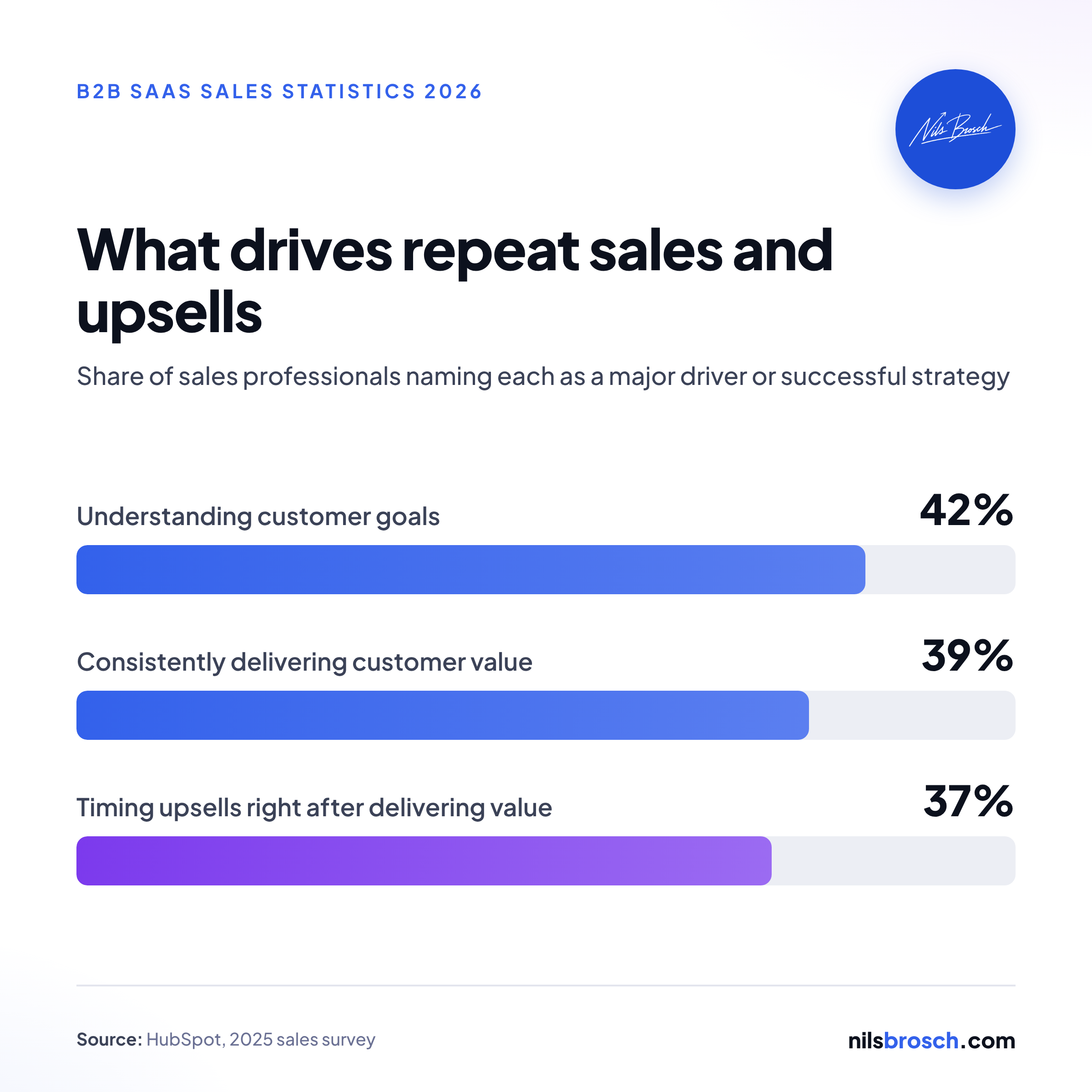
- 42% of sales professionals say understanding customer goals is a major driver of repeat sales and upsells, according to HubSpot's 2025 sales survey. (Source)
- 39% of sales professionals say consistently delivering customer value is a major driver of repeat sales and upsells, according to HubSpot's 2025 sales survey. (Source)
- 37% of sales professionals say timing upsells right after delivering value is a successful strategy, according to HubSpot's 2025 sales survey. (Source)
How to interpret these B2B SaaS sales statistics
Do not compare incomparable denominators. A call connect rate is not a booked-meeting rate; an SQL-to-won rate is not an opportunity win rate; net revenue retention includes expansion while gross revenue retention does not.
Use a cohort before a company-wide average. Compare inbound and outbound separately. Separate SMB, mid-market and enterprise, and measure conversion both by lead source and by opportunity creation period.
Prioritize capabilities over activity volume. In practice, revenue leaders should coach the quality of discovery, the buyer's quantified desired outcome, next-meeting commitments, multithreading and compelling demonstrations, rather than simply requiring more calls.
Treat vendor studies as observational. These figures are often generated from customers of sales technology vendors or from surveys. They identify useful patterns, but rarely establish that a specific intervention caused an uplift.
Frequently Asked Questions
What is a good B2B SaaS sales win rate in 2026?
How many cold calls does it take to book a SaaS demo?
How do you improve discovery-to-demo and demo-to-close conversion?
Are B2B SaaS sales cycles getting longer?
Cite this page
Feel free to use any statistic from this page in your own work. Please link back to this page as the source.
Brosch, N. (2026). 200+ B2B SaaS Sales Statistics You Need to Know in 2026. nilsbrosch.com. https://nilsbrosch.com/blog/b2b-saas-sales-statistics<a href="https://nilsbrosch.com/blog/b2b-saas-sales-statistics">B2B SaaS sales statistics</a> (Nils Brosch, 2026)
About the author
Nils Brosch is a B2B SaaS and AI sales trainer based in the Netherlands. He has manually reviewed 1,400+ sales calls across 140+ European SaaS and AI teams and runs tailor-made sales training and coaching programs for companies in Benelux and DACH. Before that he co-founded TravelCircus, was CCO at Recruitee (Tellent) and Director Sales Europe at Amplitude. More about Nils · LinkedIn
Turn these statistics into a plan for your team
Industry averages tell you where the market is. Your own calls tell you where your team loses deals. My free Gap Analysis scores two of your calls against the 22-criteria benchmark behind this article. Benelux and DACH, in person or remote.